

April11, 2024 – In the lead-up to the November 2024 U.S. presidential election, Pollara Strategic Insights is regularly polling Canadians about their views and feelings about the race. We’ll be sharing some select findings from these surveys on our website as well as exclusive commentary at The Hub.
More extensive, in-depth survey results and analysis of Canadian and American attitudes about the race for the White House will be reserved for subscribers to our syndicated study on the 2024 US Presidential election. In addition to providing monthly updates on how Canadians feel about the US election, Pollara has partnered with Emerson College to provide subscribers with regular reports on polling among Americans. This will include polls and analysis on the primaries, presidential election, and key gubernational/state elections. Subscribers will also receive invites to exclusive seminars with experts at Emerson College. See full details of the poll findings and subscription information here.
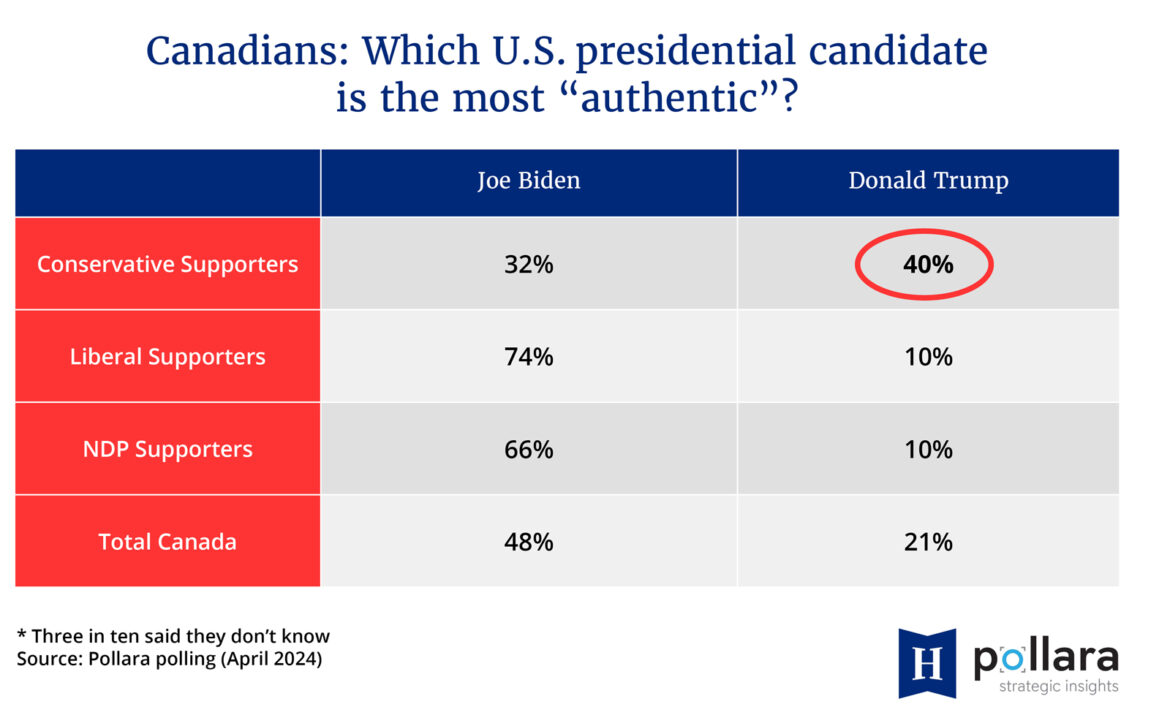
The theory of cognitive dissonance was first introduced by psychologist Leon Festinger in 1957. It refers to the discomfort a person feels when their behaviour does not align with their values or beliefs. Accordingly, cognitive dissonance is recognized as a psychological phenomenon occurring when a person holds two contradictory beliefs at the same time. Our latest findings suggest that many Canadian Conservative voters may well be suffering from this affliction. It will be something for them to ponder over as many of them gather in Ottawa for this week’s Canada Strong and Free Networking Conference. In a study conducted between March 15th and 22with 1,500 adult Canadians, we at Pollara found that 41 percent of Conservative voters would like to see Donald Trump win the next presidential election, compared to 37 percent supporting Joe Biden, and 23 percent unsure. This stands in sharp contrast with our national results where 61 percent of all Canadians preferred Biden compared to 18 percent for Trump. What’s perplexing is that while Trump is the preferred candidate for Canadian Conservatives, 42 percent of those same voters think a second Trump presidency would be bad for Canada. Only 27 percent of Conservative voters think it would be a good thing for our country.
Graphic credit: Janice Nelson.
There is no denying the importance of authenticity in politics. In the year 2023, Merriam-Webster declared “authentic” as their coveted word of the year, defining it as “worthy of acceptance or belief as conforming to or based on fact.” This acknowledgment highlights the term’s significance today, reflecting its prevalence in our thoughts, writings, aspirations, and judgments more than ever before. It is hard to articulate what makes a leader “authentic.” But understanding authenticity is important even if it is “in the eye of the beholder.” And it appears to be influencing vote choice. Experts and pundits like to discuss the importance of policies in shaping vote choice but the existence of the truly rationally-operating voter may be a myth. It remains that regular people spend very little time thinking about politics. They are more likely to be influenced by how they feel about a candidate than by policy platforms. This explains why a factor like “authenticity” overrides policy concerns.
Justin Trudeau’s authenticity problem
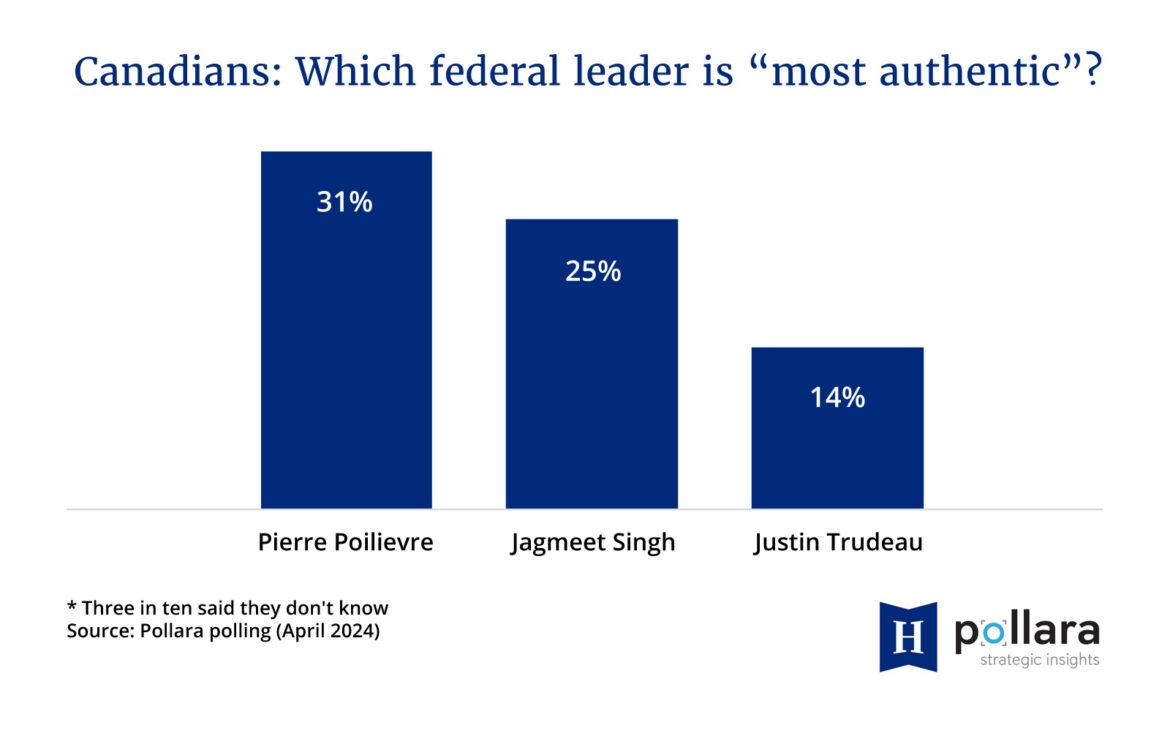
If this is the case, our data is worrisome for Prime Minister Trudeau. While Canadians will not be voting in the U.S. election in November 2024, there will be a Canadian election at some point in 2025. When our polls asked “Who is the most authentic Canadian federal party leader,” 31 percent of Canadians chose Conservative leader Pierre Poilievre, ahead of NDP leader Jagmeet Singh at 25 percent.
Graphic credit: Janice Nelson.
Only 14 percent of Canadians selected Liberal leader Justin Trudeau. There are several factors suggesting that Prime Minister Trudeau is facing a major uphill battle for re-election. A lack of authenticity may well be the most ominous.
For more survey results and commentary, see today’s column in The Hub. To receive all of the insights and benefits of our ongoing syndicated study on the 2024 US Presidential election, please subscribe here.