
November 26, 2025 – Today, Mental Health Research Canada (MHRC) released new research – conducted in partnership with Pollara Strategic Insights – revealing how gambling is associated with negative mental health outcomes, particularly among individuals who experience problem gambling. For these Canadians, gambling can contribute to significant financial strain, social isolation, psychological distress, and in some cases, suicidal ideation.
Key findings from the research include:
- 73.1% of adult Canadians reported participating in some form of gambling.
- According to the Problem Gambling Severity Index (PGSI), 9.1% were classified as people with problem gambling, concentrated among young men and those who participate in online gambling.
- People with problem gambling were 4 times more likely to indicate symptoms of anxiety and depression according to the GAD-7 and PHQ-9 compared to those who gamble but were not at risk.
- Those with problem gambling were 4 times more likely to thought about suicide and 7 times more likely to have planned a suicide in the last 12 months.
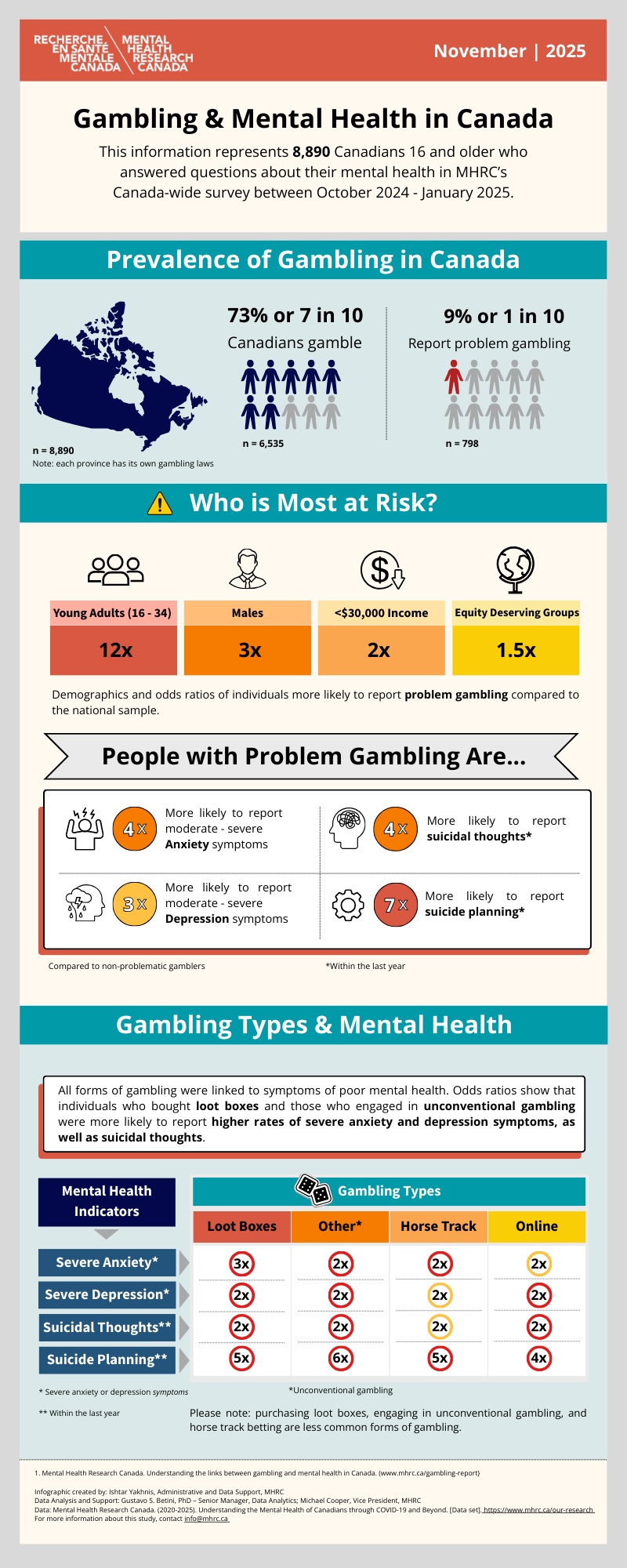
The research was based on quantitative and qualitative studies designed, conducted, and analysed by Pollara Strategic Insights on behalf of MHRC, including an online survey of N=8,890 adult Canadians fielded from October 2024 to January 2025 and an in-depth one-on-one qualitative interview study conducted between December 2024 to March 2025 amongst 51 Canadians who met the criteria to be identified as engaging in moderate-high risk gambling or problem gambling according to the Problem Gambling Severity Index (PGSI; Wynne & Ferris, 2001).
Visit the MHRC website for more information about their research on the mental health impacts of gambling, and to download the reports for High Stakes: A Mental Health Perspective on Gambling in Canada(the quantitative research report) and The People Behind the Statistics: Lived Experiences of Gambling and Mental Health(the qualitative in-depth interview study report).
In addition, earlier this month, the Canadian Centre on Substance Use and Addiction (CCSA) released a new report – Online Gambling among Young Canadians: A Call to Action – developed in partnership with MHRC and Greo Evidence Insights, and based on an online survey conducted on their behalf by Pollara Strategic Insights amongst N=8,211 adult Canadians from October 24 to November 12, 2024. The study highlights how young Canadians aged 18 to 29 are at higher risk of suffering from high levels of gambling-related harms, including financial, emotional, psychological, and relationship harms. Some of the key findings include:
- About a third (32%) of young adults aged 18 to 29 reported gambling online.
- Among young adults aged 18 to 29 who gambled online within the past year, 23.5% reported experiencing a high level of gambling-related harms, including reduction of savings, increased credit card debt, and compromised well-being due to feelings of regret and self-perceived failure.
- Online gambling is significantly riskier than other forms of gambling. Compared to people who played lottery only, people who reported gambling online in the past year were :
- About 10 times more likely to exceed lower-risk gambling thresholds
- Over 45 times more likely to meet the criteria for problem gambling, and
- More than 20 times more likely to report high levels of gambling-related harm.
Visit the CCSA website for more information about this study and to download the full report. If you would like access to the data tables for both the MHRC and CCSA reports, please visit the MHRC data hub to view and interact with the data.