

November 18, 2025 – Today, the Canadian Association of Financial Institutions in Insurance (CAFII) released the Credit Protection Insurance Segmentation Study – a groundbreaking, comprehensive piece of survey research conducted on their behalf by Pollara Strategic Insights. The study found that half of Canadian mortgage holders could only maintain their lifestyle for less than six months without their primary income.
The Credit Protection Insurance (CPI) Segmentation Study was conducted from July 9 to 22, 2025 via an online survey of 3,521 Canadian mortgage or HELOC (home equity line of credit) holders. The research identified five distinct consumer segments and analysed their financial vulnerability, protection needs, purchase behaviours, and attitudes toward CPI. The survey reveals widespread financial stress alongside troubling gaps in protection confidence, even among those who already have insurance coverage. The survey analysis identifies critical gaps in protection awareness and confidence, pointing to opportunities for industry to better serve financially vulnerable families.
The research, the first in Canada to map behavioural segments among current and potential CPI customers, found that 44% of mortgage holders report the current economic situation is negatively impacting their personal finances, while 57% have concerns about job loss in the next 12 months. Perhaps most concerning: 50% say they would have serious problems paying bills if their main earner were unable to work.
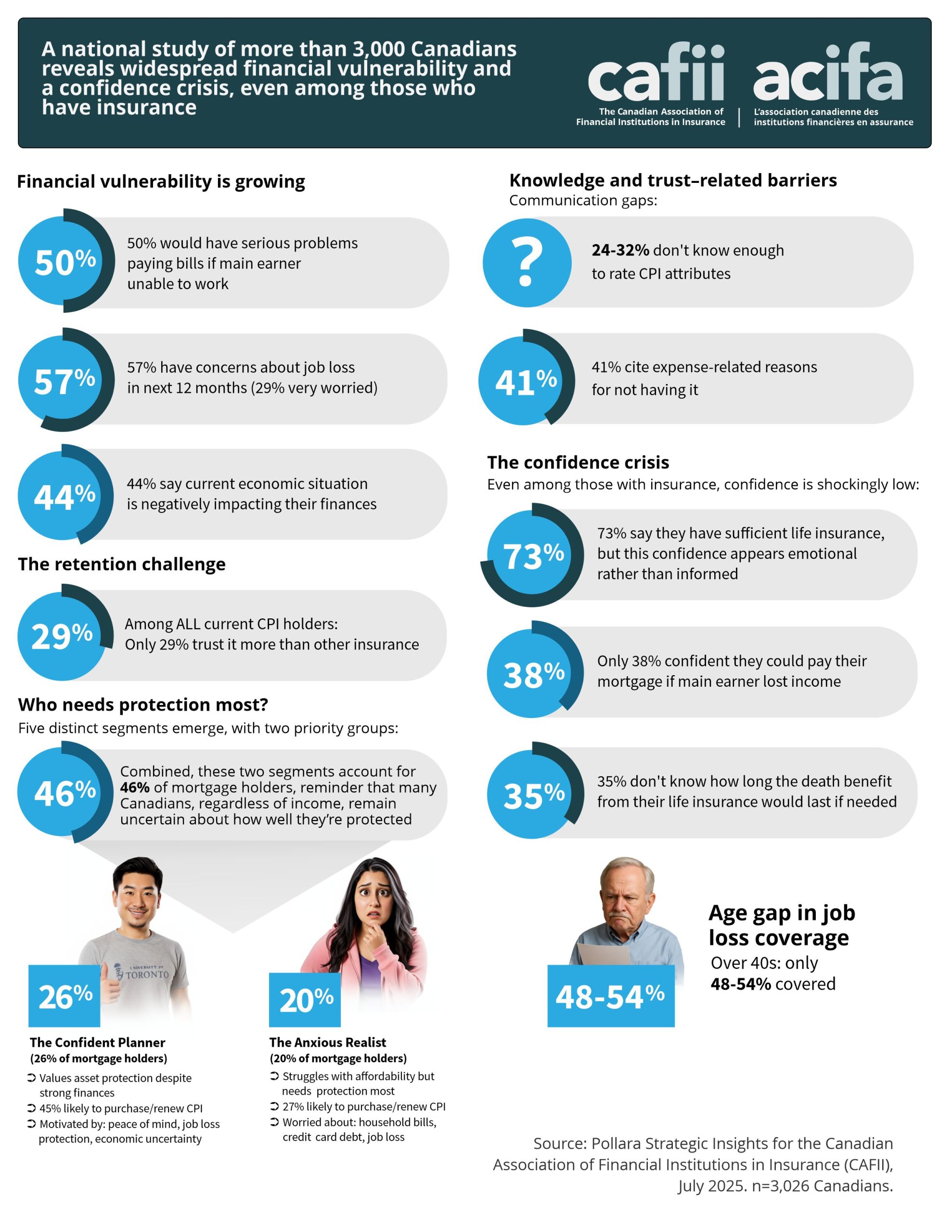
“This study shows a troubling contradiction: Canadians know they’re vulnerable, yet many remain underinsured or uncertain about the protection they do have. Only 38% feel confident they could cover their mortgage if the main earner lost income, and more than a third don’t even know how long their life insurance would last,” said Keith Martin, Executive Director, CAFII. “With average household debt levels so high, these blind spots leave families exposed at the worst possible time. The challenge for our industry is not just providing insurance, but making sure Canadians understand and trust the protection available to them. This research provides the CPI industry with a roadmap for better meeting the needs of financially vulnerable Canadians. The opportunity exists to close protection gaps, improve communication, and demonstrate value, particularly during life transitions and economic stress when families need protection most.”
The research identified five distinct consumer segments, with two groups that represent 46% of mortgage and HELOC holders standing out as having the greatest need for protection and support:
- The Confident Planner (26% of mortgage/HELOC holders): Despite strong financial positions, this segment values CPI for asset protection, with 45% likely to purchase or renew coverage.
- The Anxious Realist (25% of mortgage/HELOC holders): Struggling with affordability but standing to benefit most from protection, with 27% likely to purchase or renew despite financial constraints.
Although some mortgage and HELOC holders have CPI (29% and 22% respectively), important gaps remain especially in job loss protection. Only 66% of mortgage-related CPI includes job loss coverage, compared to 94% for life coverage. The gap is particularly pronounced among those over 40, with only 48-54% having job loss protection compared to 79-95% of those under 40. The study reveals that even among current CPI holders, concerns persist, as only 30% agree the product provides good value for money, and just 29% find it affordable or trust it more than other insurance types.
Most Canadians learn about Credit Protection Insurance from banks and credit unions (67%), and more than half of purchases (53%) take place there. However, the research found that only 39% of non-holders recall being informed about CPI options and 48% were advised against CPI by financial professionals, highlighting that consumers may be receiving mixed messages or no information at all – and need better support in making informed choices.
For more details and learnings from this important study, see the CAFII press release, the segmentation study report (including profiles of each segment), and the associated data tables, and Pollara Senior Vice President Lesli Martin’s webinar summarizing the study findings.